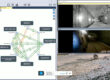

When teams deploy into disaster zones, underground infrastructure, remote terrain, dense urban environments, or hostile conditions, the first thing to disappear is often the very thing operations depend on: communications infrastructure.
No towers.
No fibre.
No backhaul.
No permissions.
And yet the mission continues.
The Problem with Traditional Networks
Most communications systems rely on fixed infrastructure:
- Cellular towers
- Internet backhaul
- Repeaters
- Satellite uplinks
- Centralised routing
If that infrastructure is damaged, overloaded, unavailable, or denied, your communications capability collapses with it.
For emergency services, defence units, search & rescue teams, and industrial operators, that is not a minor inconvenience — it is operational risk.
Mesh Radios: A Network That Forms Around Your Team
Mesh networking takes a different approach.
Instead of relying on a central tower or fixed backbone, each device becomes part of the network itself.
Power the radios on, and:
- Each node connects to nearby nodes
- Data routes dynamically across the network
- Paths automatically reconfigure if a node moves or drops
- Coverage extends organically as the team advances
There is no single point of failure.
The network adapts.
Extends.
Heals itself.
If your team can get there, the network can too.
Built for Environments Where Infrastructure Fails
This is not theoretical.
Mesh networks prove their value in places such as:
- Disaster Zones
- When cellular networks are damaged or overwhelmed, mesh restores on-the-ground coordination.
- Tunnels & Underground Infrastructure
- GPS is unreliable. Cellular signals fade. A self-forming network maintains data and positioning flow.
- Forests & Remote Terrain
- No coverage maps required. The network expands with the team’s movement.
- Temporary Deployments
No waiting for fibre runs, permits, or third-party access. Deployment is measured in minutes.
Beyond Voice: Data, Positioning & Situational Awareness
Modern operations require more than push-to-talk.
Mesh networks support:
- Real-time data transmission
- Video feeds
- Sensor integration
- Team tracking (even in GPS-denied environments
- Cross-device interoperability
When combined with resilient hardware platforms and intelligent routing, the result is a communications layer that exists independently of public infrastructure.
That independence is the difference between delay and deployment.
Why “Bring Your Own Network” Matters
Relying solely on external infrastructure introduces variables you do not control:
- Third-party outages
- Regulatory constraints
- Congestion
- Physical vulnerability
Bringing your own network removes that dependency.
It gives teams:
- Control
- Resilience
- Predictability
- Operational continuity
- And in critical environments, continuity is capability.
Sovereign Systems: Communications Without Compromise
At Sovereign Systems, we design and deploy infrastructure-independent communications solutions built for:
- Emergency services
- Tactical teams
- Critical infrastructure operators
- Remote industrial environments
Our mesh-based architectures ensure that when the environment removes conventional connectivity, your operations do not stop.
Because in the places that matter most, there often isn’t a network.
So bring your own.