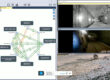

While each mesh node can appear similar to a repeater, it is fundamentally more than that. A traditional repeater simply receives and retransmits a signal from a fixed point. A mesh node, by contrast, acts as a radio, a router, and an intelligent participant in a distributed network — dynamically choosing paths, adapting to change, and strengthening the system as a whole.
In critical communications, failure isn’t theoretical. It’s inevitable. Power drops. Infrastructure gets damaged. Terrain blocks signals. Equipment fails. The real question isn’t if something will fail — it’s what happens when it does.
That’s where the difference between traditional repeater systems and mesh networks becomes very clear.
How Traditional Repeater Systems Work
Most conventional radio systems rely on a repeater.
The model is simple:
Radio → Repeater → Radio
The repeater acts as a central hub, typically mounted on:
- A tower
- A rooftop
- A hilltop
- A mast or elevated structure
It receives signals from one radio and retransmits them so others can hear.
This works well — until the repeater becomes unavailable.
The Single Point of Failure Problem
Repeaters introduce a structural vulnerability: centralisation.
If the repeater:
- Loses power
- Is physically damaged
- Falls outside coverage range
- Becomes overloaded
- Experiences interference
The network degrades — or stops entirely. Every user depends on that one elevated point. In controlled environments, this risk can be mitigated. In disaster zones, tunnels, remote terrain, or rapidly changing operations, it becomes a liability.
How Mesh Networks Are Architecturally Different
Mesh networks remove the central hub entirely.
Instead of relying on a single repeater, every device:
- Communicates directly
- Routes traffic
- Extends coverage
- Strengthens the network
There is no “tower” to protect. No single dependency to lose. The network exists between the nodes — not above them.
What Happens When Something Fails in a Mesh Network?
Failure still happens. Devices run out of battery. A unit moves out of range. Equipment gets damaged. But the behaviour is fundamentally different.
If one mesh node drops:
- Traffic automatically re-routes
- Alternate paths are used
- Coverage adapts dynamically
- Users continue operating
This is known as self-healing routing. The network is not dependent on one route. It constantly calculates the best available path. Losing one node does not collapse the system.
Repeater Logic vs Mesh Logic
Repeater Logic:
One supports many.
Mesh Logic:
Many support each other.
That architectural difference determines resilience.
Why This Matters in High-Risk Environments
In high-stakes operations — search and rescue, emergency response, industrial safety, underground operations — communication cannot hinge on a single structure.
If infrastructure is compromised, teams still need:
- Voice
- Data
- Video
- Location tracking
- Situational awareness
Designing communications without single points of failure isn’t a luxury. It’s a risk management decision.
When Repeaters Still Make Sense
Repeaters are not obsolete.
They can be effective in:
- Stable, predictable environments
- Fixed installations
- Areas with reliable power and maintenance access
But when operations are dynamic, mobile, or exposed to disruption, centralised infrastructure introduces avoidable risk.
The Bottom Line
A repeater failure can take down a network.
A mesh node failure does not. Because mesh is not built around one point — it’s built around many.
In resilient communications design, architecture matters more than output power.
Removing single points of failure is where true robustness begins.